 Prose
Prose
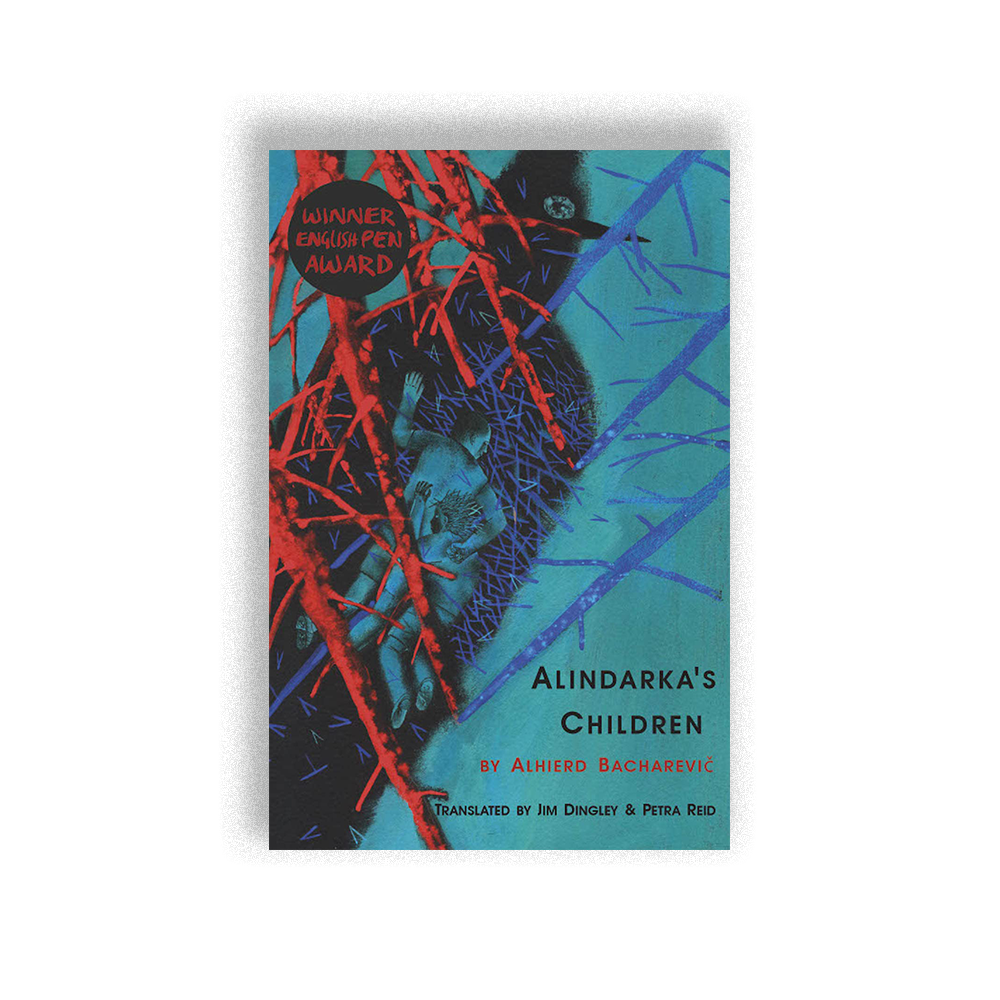
Description
Alicia and her brother Avi are imprisoned in a camp on the edge of a forest where children are trained to forget their language through therapy, coercion, drugs, and laryngectomy. The Leid (or Belarusian language) is considered a disease to be cured and replaced by the only pure form of language, the Lingo (Russian). In a modern-day Hansel and Gretel-style adventure, the children escape into the forest and find themselves in even greater danger… A masterful feat of translation, Bacharevic’s story is brilliantly rendered into English and Scots from Russian and Belarusian.
Review
“Bacharevic’s rich, provocative novel offers a kaleidoscopic picture of language as a fairy-tale forest, as a Gulag, as a monument, as a tomb, as everlasting life.”―The New York Times
‘What we get is a book that is both a translation and a collage—an independent, multilingual literary work. It is an ingenious response to the novel’s polyphony and a tribute to the Scottish language that echoes the tribute Bacharevič pays to the Belarusian tongue.’―New York Review of Books
“Readers will be stirred by Bacharevič’s ardent, earnest devotion.”―Publishers Weekly
‘You can interpret this book on many levels, from the philosophical and psychological analysis of what it means for a nation and its people to have their mother tongue removed, controlled, and suppressed, to an exciting tale of two runaway children in a forest trying to survive on blueberries and avoid the threatening adults they encounter along the way.’―The Scotsman
‘Kafkaesque and with elements of cyberpunk. Alhierd Bacharevic is the foremost figure of today’s Belarusian literature.’―New Eastern European
‘Bacharevic hits you in the eye with the truth, and it hurts.’―Maria Martysevich
About the Author
Alhierd Bacharevič grew up in a country torn by linguistic divisions. Although he grew up speaking Russian, Bacharevič rebelled by speaking and writing in Belarusian. In the 1990s, he was the founder and lead singer of the first Belarusian-language punk band, Pravakacyja (“Provocation”). He is now an award-winning author, and his works have been translated into French, German, Czech, Ukrainian, Bulgarian, Slovenian, Russian, Polish, and Lithuanian.
Raised in post-industrial Lanarkshire, Petra Reid studied law at the University of Edinburgh and worked as a general practice solicitor, and more recently as a welfare rights adviser. She studied fine art while raising a family and developed her interest in poetry through Dada. She performs site-specific pieces at one-off events. She has wandered the east coast of Scotland with a west coast accent for forty years. This is her only qualification for putting other authors’ works through the mincer of Scots—or at least her version of what may, after all, be a dialect without an army or navy.
Jim Dingley is a respected translator and expert in European languages and studies, with affiliations with Imperial College London and University College London. He has a lifetime’s worth of experience translating Belarusian into English.
Reviews
There are no reviews yet.