Prose
Prose Poetry
 Translations
 For children
 Maps
Maps Games
Games

Results of the study of demand for Belarusian books abroad for 2025
Prepared by Ilya Andreyeu
At the end of 2025, a survey was conducted to analyze the needs and preferences of target consumer groups:“Help us better understand what books Belarusians need abroad1“. The survey was conducted from December 1 to December 31. 584 people took part in the survey (online: 543, offline: 41). The largest share of participants was from Poland (about 47%), mostly from cities (Warsaw, Krakow, etc.).
The aim of the survey was to obtaininformation about reading habits and interests of the target group, which identifies itself as lovers of Belarusian books.
The survey, along with the study of the publishing market abroad, emphasizes the necessity to conduct such studies on a regular basis in order to identify long-term dynamics.
Comments on the results
-
The market for Belarusian books in the online segment is formed around two dominant age groups: 18-35 and 36-55 years old, which are characterized by high engagement and language loyalty, as well as the strong influence of social networks on consumer choice. The main constraints to growth are not lack of demand, but insufficient assortment, information coverage and accurate segmentation.
-
More than 77% of respondents read regularly – daily or several times a week. This allows the sample to be considered an audience with a stable reading habit.
-
Almost half of the respondents from the “warm” audience – people who already read in Belarusian and are ready to financially support publishers – note the lack of literature they need.
-
Belarusian is the obvious language of choice in the surveyed group. At the same time, a considerable part of respondents are ready to buy books in other languages as well. (Belarusian – 86.7%, English – 25.5%, Polish – 19.7%, Russian – 18.3%, original language – about 13.8%; multiple choice).
-
The vast majority of respondents prefer paper books – they were chosen by about 81% of respondents. Electronic formats (ePub, PDF, etc.) have a noticeable audience (26%). Meanwhile,audiobooks are not yet a growth driver, but rather asupplement(about 9%).
-
Buying books online remains the main way to purchase them. Publishers’ websites dominate (about 70%;several answers are allowed ); markets account for more than a quarter ofsales (about 30%). Offline events with publishers, meetings with authors, etc. play an important role (about 50%). About 40% of books are purchased in physical stores. Almost a quarter receive books as gifts. This distribution reflects not the quantitative distribution of sales volumes, but the very fact of buying books.
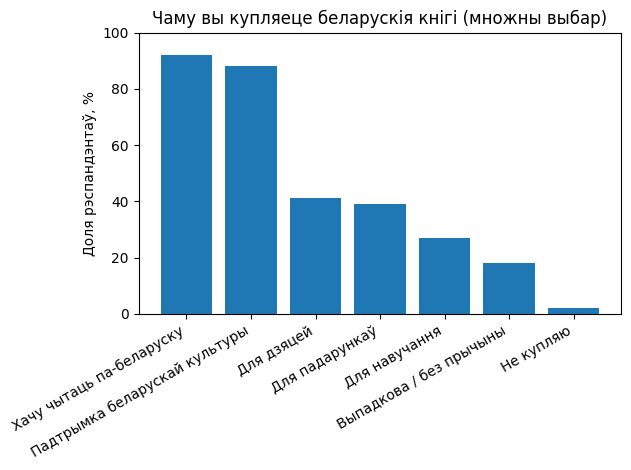
7. The main factor is value motivation (love for the native language, language practice, etc.) rather than utilitarian necessity. Belarusian language is perceived as an element of identity and belonging to the community. (Question 18. Why do you buy books in Belarusian?)
8. The greatest influence on the decision to buy a book is the name of the author – it is mentioned by about 70% of respondents. Recommendations of friends and acquaintances also play a significant role (about 60%). About half of the survey participants pay attention to book awards and nominations. Advertising in the media and social networks, as well as sales and discounts have a smaller but still noticeable influence – about a third of readers mention these factors. Responses show that the content and theme of the book, as well as personal reading preferences, also play a significant role.
9. Social networks and book bloggers are the main source of information about new Belarusian books (82%). Media and publishers’ websites (47%) also play a significant role, as do recommendations from friends and acquaintances (about 40%). Events and random “discoveries” have a secondary but stable influence.
10. The main obstacle to reading and buying books in Belarusian is the lack of suitable literature – this was pointed out by 48% of respondents. Economic factors (high cost of books – 25%, delivery – 20%) are significant, but not decisive. This is confirmed by the stated willingness to buy expensive editions (question 12. The price threshold of 25euros per book was indicated by 40% of respondents, and about 60% expressed willingness to buy a “good” book for a higher price). An important factor deterring purchases is mobility: 28% of respondents said that they refrain from buying books because of possible relocation and difficulties with transportation. Lack of time (25%) is more universal and is not directly related to the language of books or their availability on the market.
11. Reading preferences (“What do you read most often?”; multiple choice with the possibility to give your answer).
Among the most frequently mentioned genres:
– fiction – about 55% of responses
– scientific and popular science literature – about 55%
– Belarusian classics – about 48%
– historical literature – about 43%
– translations – about 58% of responses (* – not a genre, but a separate group)
– Science fiction and fantasy – about 38%
– children’s literature – about 25%
– poetry – about 22%
-
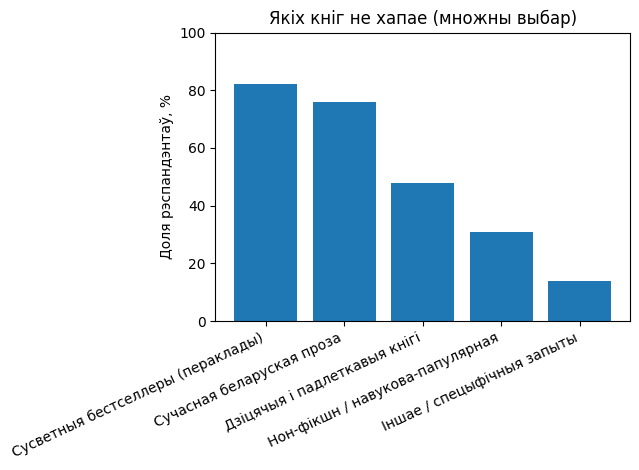
Lack of genres and themes (“What books are missing?”; multiple choice with the option to enter your own answer).
The most notable gaps identified in the answers:
– world bestsellers / modern translated literature – about 62-65 %
– modern Belarusian prose – about 55-58%
– literature for young people – about 35% (apparently, an overestimate)
– detectives, thrillers, genre “light” prose – about 30-35%
–professional/academic literature in Belarusian – about 15-20%
The first three answers were offered as options; comparison with “open” answers shows that in the case of literature for young people there was a hint effect. Open answers confirm the demand for world bestsellers, but shift it towards lighter genres (self-help, philosophy, sociology, popular science, etc.).
Conclusions
In general, the market of Belarusian books abroad is supported by a loyal and permanent audience with a clear value motivation. The main limitations are related not to the lack of demand or high prices, but to the lack of supply, information coverage, and availability of books. This means that the market has potential for systematic growth (expansion of theassortment,targeted communication with segments of readers,improvement oflogistical accessibility).
The book promotion strategy should be based on systematic work with book bloggers, direct communication with readers through meetings with authors and presentations, and the use of storytelling elements. The author’s media profile and public activity remain an important factor in attracting attention and building trust. For lesser-known authors, other reader retention mechanisms can play an important role – primarily series, but also a clear conceptual vision of the publishing house and the publisher’s personality, which becomes a kind of quality mark.
The most popular book remains the “translated bestseller” paperback, and the most anticipated book can be called the “popular and useful” book. The desire to “support” remains an important motive for buying books. However, it can be predicted that over time, readers will increasingly choose books not out of solidarity, but according to their own requirements and tastes.
Notes
One limitation of the study is that the survey was conducted among a “lukewarm” audience, which likely overestimated interest and loyalty rates.
The survey, as well as the analysis of the results, received a number of methodological comments and recommendations from an anonymous expert, which were taken into account. The comments concerned the age structure (the 18-25 age group was not singledout ) and the useof non-quantitative indicatorsin the range of values (“at any cost”).
However, some ‘irrelevant’ or difficult to handle survey items (e.g. suggestions about what books should be published) served as a community-basedapproach– they helped to involve the audience in the choice of topics and publications. It also allowed the personal opinions of virtually every participant to be heard.
1 The survey was conducted toanalyze the needs and preferences of target groups within the framework of the Art Power Belarus sustainable development grant supported by the European Union.